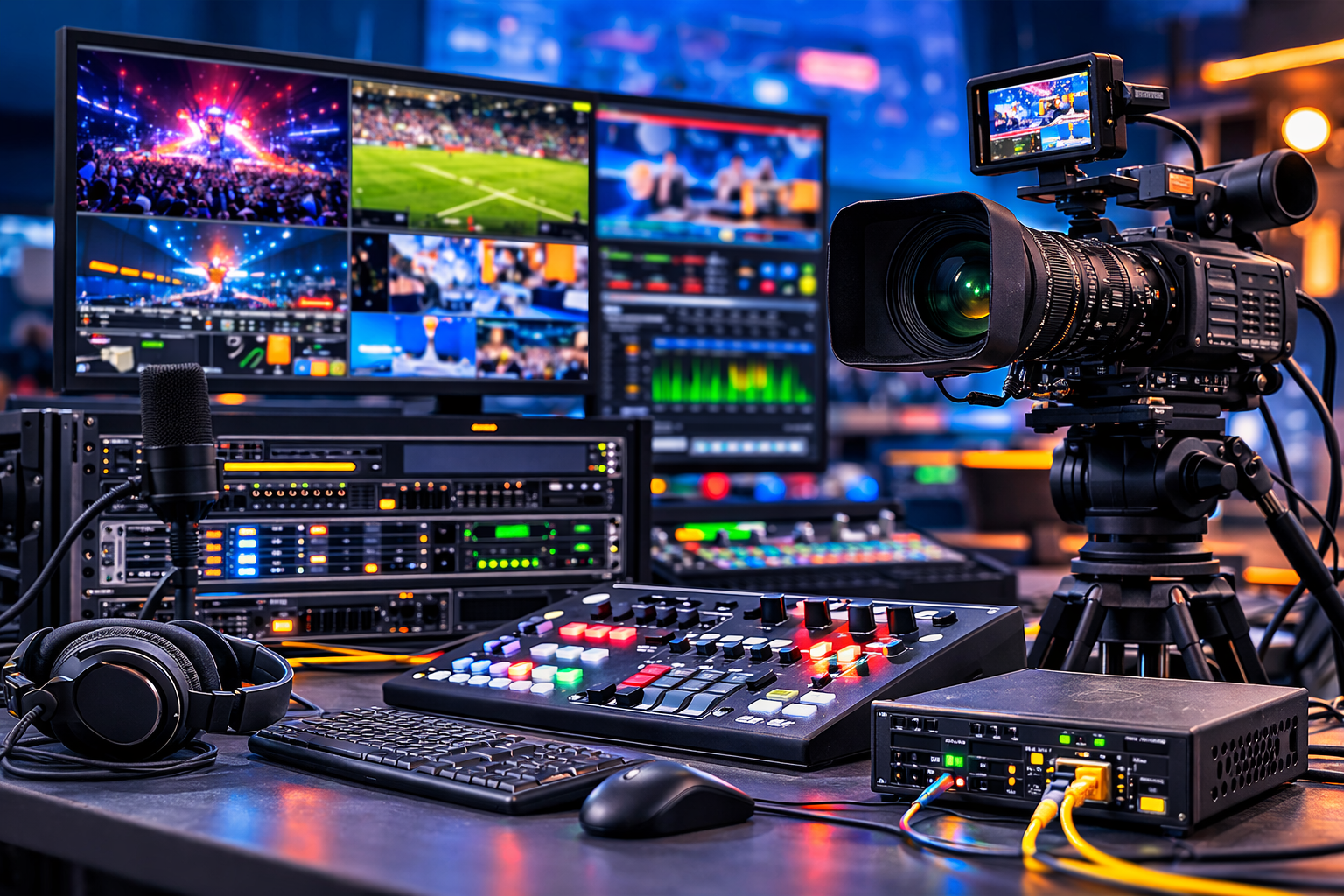
Rapid Shift Toward IP Technology Transforming Live Broadcasting
The live IP broadcast equipment industry is experiencing significant growth as broadcasters and content creators increasingly adopt Internet Protocol based technologies for live video production and distribution. These systems enable the capture, processing, and transmission of live audio and video through IP networks, providing greater flexibility, scalability, and cost efficiency compared to traditional broadcasting infrastructure.Rising demand for live streaming, expansion of OTT platforms, growth in the media and entertainment sector, and advancements in technologies such as 5G, cloud based production, and ultra high definition content are major factors driving the adoption of live IP broadcast equipment worldwide. The global Live IP Broadcast Equipment Market is entering a phase of rapid transformation as media production and content distribution shift toward internet-based technologies. Live IP broadcast equipment refers to the tools and systems that capture, process, and transmit live audio and video through Internet Protocol networks instead of traditional broadcasting infrastructure such as satellite or coaxial systems. These solutions enable broadcasters and content creators to deliver high quality live content with greater flexibility, scalability, and efficiency. The market was valued at US$ 1.84 billion in 2024 and is projected to reach US$ 5.66 billion by 2031, registering a strong CAGR of 17.6% during 2025–2031. The rising demand for live streaming across industries such as media and entertainment, sports broadcasting, gaming, corporate communication, and digital events is a key factor driving this growth. As audiences increasingly prefer real-time content and interactive viewing experiences, broadcasters are investing in advanced IP-based production technologies to enhance delivery speed and quality. Market Analysis One of the major drivers supporting the expansion of live IP broadcasting technology is the increasing demand for high resolution content such as 4K and ultrahigh-definition formats. Delivering such content requires efficient and high bandwidth transmission systems that IP-based equipment can support effectively. As the media and entertainment industry continues to grow globally, production companies and broadcasters are modernizing their infrastructure to accommodate high-quality live content. Organizations are increasingly adopting digital technologies to strengthen their brand visibility and enhance product promotion. Live streaming has become a key marketing and engagement tool for businesses. Companies are focusing on the development of cost effective broadcasting hardware and software solutions that support live streaming production while reducing operational complexity. Another important trend is the integration of innovative digital technologies in the broadcasting ecosystem. The combination of IP networking, cloud computing, and software-based production systems allows broadcasters to create scalable and remote production environments. These advancements enable live production teams to collaborate across locations and manage content efficiently. Get Sample PDF: https://www.theinsightpartners.com/sample/TIPRE00009383 Market Overview Live IP broadcast equipment plays a crucial role in enabling modern broadcasting workflows. By shifting from traditional broadcasting systems to IP-based networks, broadcasters gain access to flexible infrastructure that supports remote production, cloud-based operations, and multi-platform distribution. The growing popularity of direct-to-consumer services through OTT platforms and multichannel networks is also accelerating demand for advanced broadcast equipment. Consumers now expect seamless viewing experiences across televisions, smartphones, tablets, and other connected devices. This shift toward multi-screen video consumption has encouraged broadcasters to adopt IP-based production solutions that can efficiently manage large volumes of real-time video data. In addition, increased investment in research and development activities is helping manufacturers introduce advanced broadcasting equipment designed for modern digital environments. Improvements in high-speed broadband infrastructure, expansion of 5G connectivity, and the growing adoption of smart devices are further supporting the adoption of IP-based broadcast technologies. Growth Drivers and Opportunities The expansion of the media and entertainment industry remains one of the most significant factors influencing the demand for live IP broadcast equipment. The increasing popularity of live sports, esports, gaming streams, news broadcasts, and digital events has significantly increased the volume of live video content produced globally. Global data also indicates strong growth in live streaming engagement. For instance, watch time for live streams on major digital platforms has increased significantly, while total hours watched for live content reached more than 32 billion hours in recent years. Younger audiences, especially Gen Z consumers, show a strong preference for real-time content because it offers authentic and interactive experiences compared with traditional television programming. Technological innovation is another important opportunity area. Companies are focusing on optimizing network bandwidth, improving video compression technologies, and developing advanced cloud production solutions. The integration of large numbers of live streaming channels into digital television interfaces and OTT platforms further expands opportunities for equipment manufacturers. Market Segmentation Insights The live IP broadcast equipment industry can be categorized based on product type and application. By product type, key segments include transmitters and gap fillers, encoders and converters, amplifiers, antennas, modulators and repeaters, routers and switches, video servers, IP synchronization equipment, PTP servers, and others. Among these, routers and switches accounted for the largest share in 2024 due to their essential role in managing data transmission across IP networks. By application, the market includes broadcast stadiums, outside broadcast vans, and broadcast production centers. Broadcast production centers held the leading share as they represent the core infrastructure for live video production and distribution. Regional Insights The industry demonstrates strong geographical expansion across North America, Europe, Asia Pacific, the Middle East and Africa, and South and Central America. Asia Pacific held the largest market share in 2024 due to rapid growth in digital media platforms, rising internet penetration, and expanding live streaming culture in countries such as China, India, Japan, and Australia. The region is also witnessing increasing investments in media production infrastructure and sports broadcasting. North America represents the second largest market, supported by a well established media and entertainment ecosystem. Major OTT platforms and streaming providers offer diverse content libraries that include live sports, movies, television series, and original productions. Strong technological adoption and high consumer demand for streaming services continue to drive equipment modernization in the region. Europe also remains an important market due to the growing popularity of digital broadcasting and the expansion of cross-border media networks. Key Players in the Market Leading companies are focusing on innovation, partnerships, and acquisitions to strengthen their market presence and expand their technology portfolios. Belden Inc. Cisco Systems Inc. Evertz EVS Broadcast Equipment Sony Corporation Harmonic Inc. Grass Valley Ross Video Ltd AJA Video Systems Inc. Imagine Communications These companies are actively developing next generation broadcasting solutions that integrate IP networking, cloud workflows, and advanced video processing technologies. Future Outlook The future of the live IP broadcast equipment industry appears highly promising as demand for live digital content continues to accelerate worldwide. Technological advancements such as 5G connectivity, cloud-based production environments, artificial intelligence driven video processing, and advanced compression technologies are expected to redefine live broadcasting workflows. In the coming years, broadcasters and digital content providers will continue transitioning from traditional infrastructure to flexible IP-based systems that enable efficient multi-platform distribution. The increasing consumption of live sports, esports competitions, interactive media events, and streaming entertainment will further strengthen demand for advanced broadcast equipment. As a result, the industry is expected to witness sustained investment, technological innovation, and strong growth through 2031. Related Report: Wire Harness Market Size and Forecast (2021 - 2031) Unit Heater Market Size and Forecast (2021 - 2031)